
Resource Guarding After Switching From Ultra-Processed Food
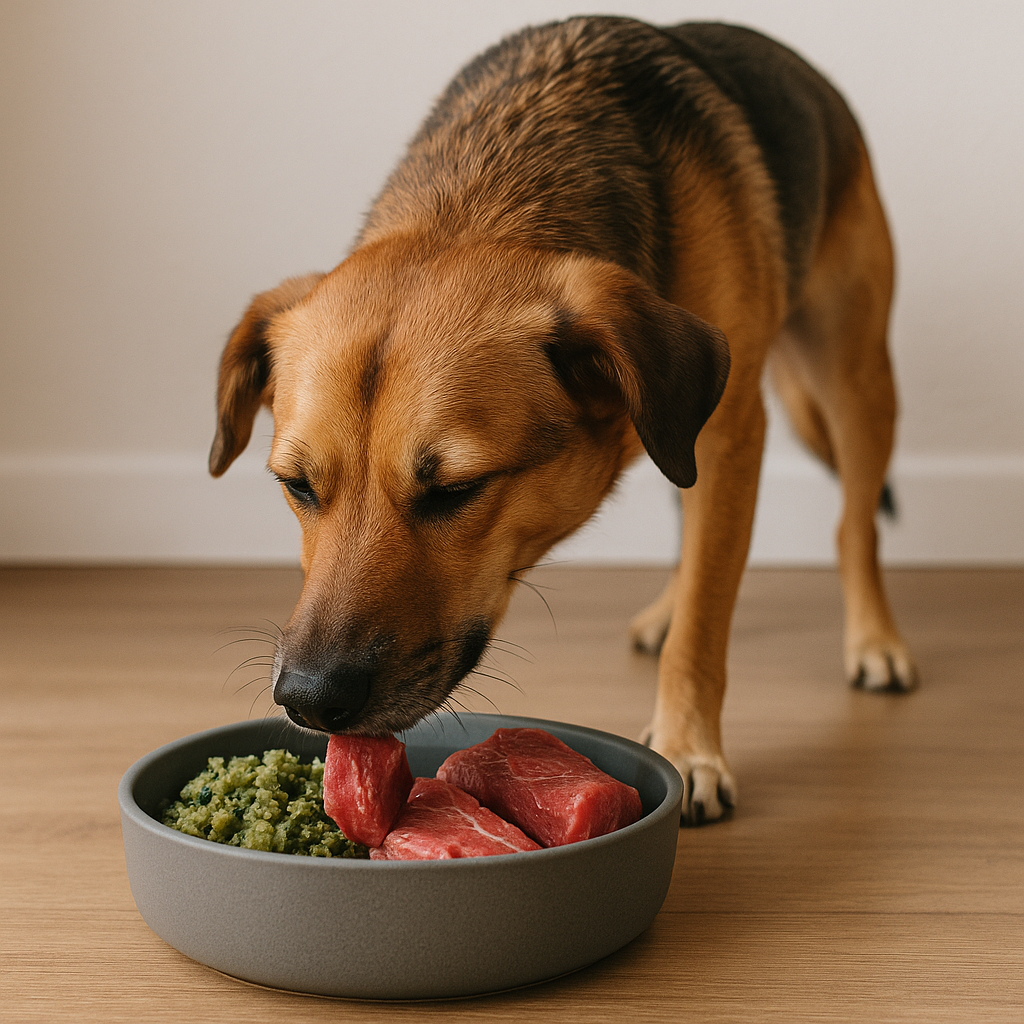
Resource Guarding After Switching From Ultra-Processed Food
Normal, predictable, and usually temporary
One of the most common panicked messages I get when someone switches their dog from ultra-processed kibble to fresh or raw food goes something like this:
> “My dog has never guarded food before, but now he’s growling. Have I created a problem?”
Short answer: no.
Longer answer: you’ve revealed a normal dog behaviour that was never worth expressing before.
Let’s unpack it properly, without myths, dominance nonsense, or advice that makes things worse.
---
What resource guarding actually is (and isn’t)
Resource guarding is not:
Dominance
Disrespect
Your dog “challenging you”
A sign your dog is going to become aggressive by default
Resource guarding is:
A fear-based, defensive behaviour
Triggered by the perceived risk of losing a valuable resource
Completely normal across species, including humans
This is not opinion — it’s consistently supported in the behavioural literature.
Multiple studies show that food-related aggression increases when dogs experience human interference, unpredictability, or previous removal of food (Reisner et al., 2007; Herron et al., 2009).
In plain English:
Dogs guard when they think something might be taken away.
---
Why it often appears when you ditch kibble
Ultra-processed kibble is:
Low smell
Uniform
Fast to eat
Emotionally boring
Fresh or raw food is the opposite:
Strong scent
Higher fat content
Requires chewing and engagement
Takes longer to eat
Feels important
Studies looking at aggression contexts show that high-value and novel food significantly increases guarding behaviours, especially early on (Casey et al., 2014).
So when someone says
> “He never did this on kibble”
Yes.
Because the food wasn’t worth defending.
You didn’t create guarding.
You raised the value of the resource.
---
The mistake people make next
This is where well-meaning but outdated advice causes problems.
Things like:
“Take the bowl away so he learns”
“Put your hand in while he eats”
“Show him you’re in charge”
“He needs to respect you”
Every single one of these increases guarding risk.
Herron, Shofer & Reisner (2009) showed that confrontational methods — including taking food, physically interfering, or asserting control — were associated with higher aggression and escalation, not improvement.
van der Borg et al. (2015) found that confrontational interactions increased physiological stress markers, including cortisol.
Translation:
You don’t teach safety by creating threat.
---
Why giving space actually works
Here’s the part people struggle with, because it feels “too easy”.
When you:
Feed in a quiet area
Stop hovering
Stop testing
Stop interfering
Let the dog eat in peace
You remove the emotional driver behind the behaviour.
No threat → no need to guard.
Reisner et al. (2007) identified that predictable, uninterrupted feeding routines were associated with lower severity and reduced persistence of food guarding.
Wrubel et al. (2011) showed that predictability reduces stress-related behaviours in dogs.
Fresh food stops being:
> “I must protect this”
and becomes:
> “This happens every day, no drama”
Once that belief settles, guarding usually fades on its own.
Not suppressed.
Not trained out.
Unnecessary.
---
Why punishing growling is especially stupid
Growling is communication.
Overall & Love (2001) found that escalation to biting was more likely when early warning signals were punished or ignored.
When you punish a growl:
You don’t remove the fear
You remove the warning
The dog still feels unsafe.
You just taught them not to tell you.
That’s how “he bit without warning” stories are born.
---
Does it always resolve on its own?
No. And anyone claiming absolutes is lying to you.
Giving space and predictability works best when:
Guarding appears only around food
It coincides with a diet change
There’s no long history of food insecurity
The behaviour softens over weeks, not intensifies
It may need professional behavioural support when:
Guarding existed long before the diet change
It generalises to toys, spaces, or people
There is snapping, lunging, or escalation
Anxiety is present across multiple contexts
But even then, space and non-interference is still step one, not something you skip.
---
The irony no one talks about
People are often more worried about guarding on fresh food…
…while feeding ultra-processed diets that dogs inhale in 30 seconds, with zero enrichment, zero engagement, and zero satisfaction.
Guarding doesn’t mean the food is dangerous.
It often means the food finally matters.
Your job isn’t to prove you can take it away.
Your job is to prove you won’t.
---
Bottom line
Switching from ultra-processed food to fresh can temporarily increase resource guarding because:
Value increases
Novelty increases
Emotional investment increases
The science consistently shows:
Guarding is fear-based, not dominance-based
Interference and confrontation worsen it
Predictability and space reduce it
As food becomes routine and safe, guarding often fades naturally
Most dogs don’t need “training” for this.
They need trust and consistency.
And honestly?
That’s usually where things go quiet again.
---
References (peer-reviewed & evidence-based)
Casey, R. A., Loftus, B., Bolster, C., Richards, G. J., & Blackwell, E. J. (2014). Human directed aggression in domestic dogs. Applied Animal Behaviour Science, 152, 52–63.
Herron, M. E., Shofer, F. S., & Reisner, I. R. (2009). Survey of the use and outcome of confrontational and non-confrontational training methods. Applied Animal Behaviour Science, 117(1–2), 47–54.
Reisner, I. R., Shofer, F. S., & Nance, M. L. (2007). Risk factors for canine food-related aggression. Journal of the American Veterinary Medical Association, 231(10), 1608–1617.
van der Borg, J. A. M., et al. (2015). Behavioural, cortisol and heart rate responses to training methods. Journal of Veterinary Behavior, 10(1), 34–41.
Wrubel, K. M., Moon-Fanelli, A. A., Maranda, L. S., & Dodman, N. H. (2011). Intermittent feeding and predictability in dogs. Applied Animal Behaviour Science, 134(3–4), 218–225.
Overall, K. L., & Love, M. (2001). Dog bites to humans. Journal of the American Veterinary Medical Association, 218(12), 1923–1934.
AVSAB (2021). Position Statement on the Use of Punishment for Behavior Modification. American Veterinary Society of Animal Behavior.
